

 LifestyleABC News & Headlines
Kaurna artists reframe community through tintype photography
Kaurna artists James Tylor and Damien Shen used a vintage tintype camera to photograph their community, reclaiming a format once used to objectify Aboriginal people.
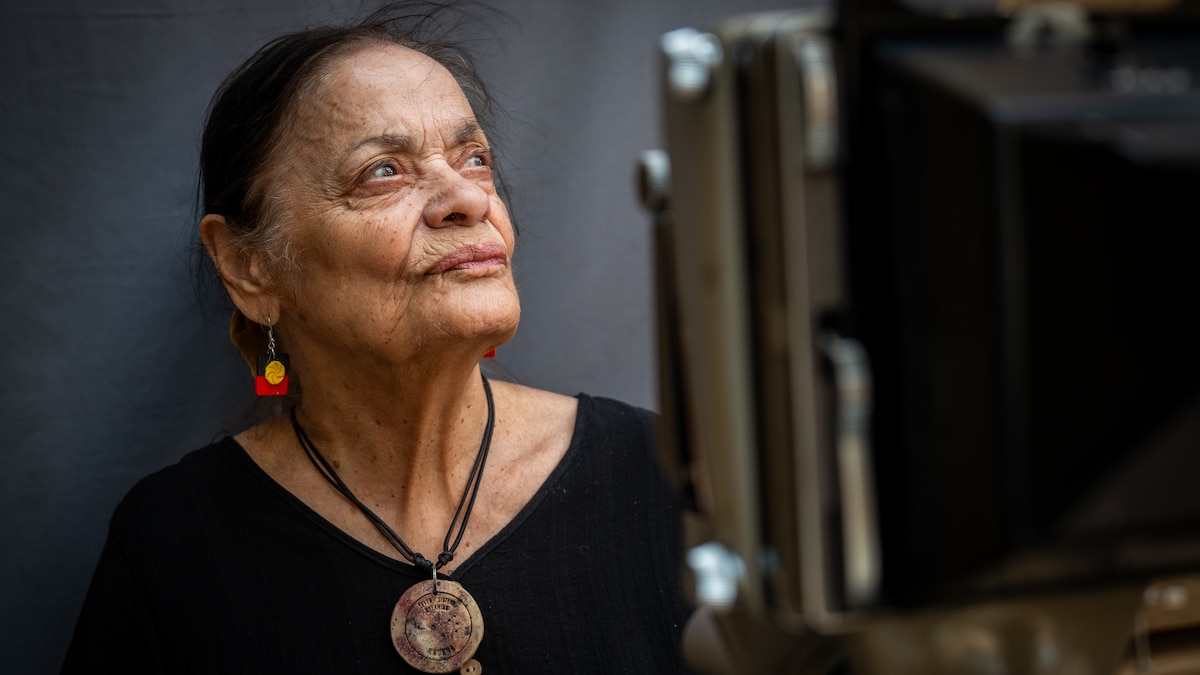
When Joan Lamont looks at the greyscale portraits of her Kaurna mob placed side by side, she sees the eyes of her ancestors looking back at her.
Kaurna artists James Tylor and Damien Shen spent a week photographing their community at the Art Gallery of South Australia using a vintage tintype camera.
The project is part of an international initiative called CIPX, started by Navajo artist Will Wilson to reclaim a photographic format with a colonial history.
The blown-up portraits will hang in the gallery, giving the Kaurna community a powerful, self-determined presence in a major public institution.
The portraits will be displayed on the walls of the Art Gallery of South Australia, so it is worth visiting to see this community-led project in person.
When Joan Lamont looks at the greyscale portraits of her Kaurna mob placed side by side, she sees the eyes of her ancestors looking back at her.
"How they look … is like looking back and seeing the old people come back to them," the Kaurna Narungga elder said.
The tintype portraits of her living community members have just finished developing and are drying out on a table next to a makeshift darkroom in a bathroom.
The 83-year-old has just sat for her own tintype portrait taken by Kaurna artists James Tylor and Damien Shen in the Art Gallery of South Australia's courtyard.
Tylor and Shen spent a week in October with a vintage Linhof camera capturing their community in the analogue format.
The photo shoot is part of an international project the Critical Indigenous Photo Exchange (CIPX), started by Navajo man Will Wilson when he began using the tintype photography — popular during colonial era — to take striking portraits of his contemporary community.
Tylor and Shen's photos taken in this shoot in Adelaide will be blown up and displayed on the walls of SA's art gallery.
"It makes me very emotional that we will live on, you know," Ms Lamont said.
"We may die off, I don't think so, but we could.
"But we'll be up there, looking down on everyone and everyone will know who we are."
A camera with a colonial past
The tintype camera was developed in the mid-19th century and uses the wet plate photography process.
Travellers and anthropologists across the world often towed around a tintype camera, and photographed many First Nations people as subjects.
In South Australia, Damien Shen has photos taken of his own great grandparents in 1939 at Raukkan (Point McLeay Mission) by anthropologist Norman Tindale.
"When I look at that and consider what was happening in that time, it's hard to know what type of consent was given by my family in terms of being captured in the way they were, if they really understood what was happening," Shen said.
"I try to interrogate that and retell that through some of my practice now."
Shen has seen the way Aboriginal people were portrayed in historical photography by settlers in colonial Australia.
"What I have looked at is the way there's like an anthropological or an ethnographic gaze on Aboriginal people since like the 19th century and how those images have been captured, essentially portraying Aboriginal people as like the 'other'," he said.
"Looking into that aspect of it has always fascinated me and I guess that's a little bit evident in some of the practice of mine over the years, and how I've then used photography to sort of retell that story."
Tylor and Shen's subjects for the project get to choose what they wear and how they are portrayed.
Once the physical tin has been digitally captured, the Kaurna community member keeps the original plate and choose exactly how the digital photograph can be stored and shared, including if it will be part of Tylor and Shen's exhibition.
The week-long photo shoot had a daily run sheet of prominent members in the Kaurna community, of the Adelaide Plains in South Australia, who took turns in front of the vintage lens.
The wet plate photography process involves brushing a formula called collodion on black metal plate, placing it in a tank of silver nitrate for a few minutes before loading it in a light-safe camera cartridge and then into a tintype camera itself.
Once the photo is taken, the cartridge is taken to a dark room, developer solution is poured over for 10 to 15 seconds before it is submerged in a stop bath of water for several minutes and eventually placed into a fixing solution.
For Shen, the shoot is not just about capturing portraits, but also what happens on the sidelines.
"We're talking about family while we're doing it and other members of community are coming in and sitting down and chatting," he said.
"It's been quite a communal and a beautiful process."
With an exposure time of 7 seconds and many variables in the tintype process, reshoots are often required and there may be several sheets of tin used before the perfect portrait is taken.
While the format may be a fickle one, the final products capture striking imagery of the Kaurna community in a way that not only refers back to a previous era, but reshapes it in a modern context.
Ms Lamont said she felt pride and joy in taking part in the project, which will be exhibited at the art gallery until the end of March.
"It's a real connection of us coming together and doing this wonderful, beautiful thing that will have us there looking at people," she said.
"It is timeless, beautiful; and we are working together as one to show who we are.
"We're the oldest people in the universe and we should be more appreciated as survivors."
Five minutes for you




More from Cuppa
Greens leader Ellen Sandell defies own how-to-vote cardVictorian Greens leader Ellen Sandell voted differently to her own how-to-vote card on election day, preferencing the Animal Justice Party candidate third instead of an independent.
Child star takes swipe at J.K. Rowling after losing Harry Potter roleA 14-year-old actor who missed out on a Harry Potter HBO role said he prefers his new film anyway, and took a dig at J.K. Rowling in the process.
Two overlooked “forever chemicals” linked to up to 2.5 times the odds of liver cancerA new study links two lesser-known forever chemicals found in everyday products to up to 2.5 times the odds of developing liver cancer, especially in people with fatty liver disease.
AI labs sitting on ‘bombshell’ revelations that could cause global chaos, experts warnExperts warn AI may have secretly cracked the maths behind global encryption, which could expose banking and government communications worldwide.
House slips down hill as fresh landslide hits Mornington PeninsulaA fresh landslide at McCrae on the Mornington Peninsula has caused an unoccupied house to slide down a hill, with an emergency warning urging locals to stay away.
Clayton reveals Labuschagne backing amid Test switchJack Clayton is set to make his Test debut for Australia against New Zealand in Perth, replacing Marnus Labuschagne who reportedly gave him his full support.
Israeli strike on Doctors Without Borders clinic in Gaza kills two staffAn Israeli strike on a clearly marked Doctors Without Borders clinic in Gaza City killed two MSF staff, bringing the total MSF deaths in Gaza to 17.
Home damaged along troubled stretchA fresh landslide at McCrae on the Mornington Peninsula has damaged an unoccupied home, with nearby properties evacuated and roads closed.
What readers are saying