

 ScienceABC News & Headlines
Japan launches first mission to collect samples from Martian moon
Japan has launched a five-year mission to collect rock samples from Mars's moon Phobos, with the capsule set to land back on Earth in Australia.
An international space mission aiming to collect sand and rock from one of Mars's moons is expected to land in Australia once the sample is retrieved.
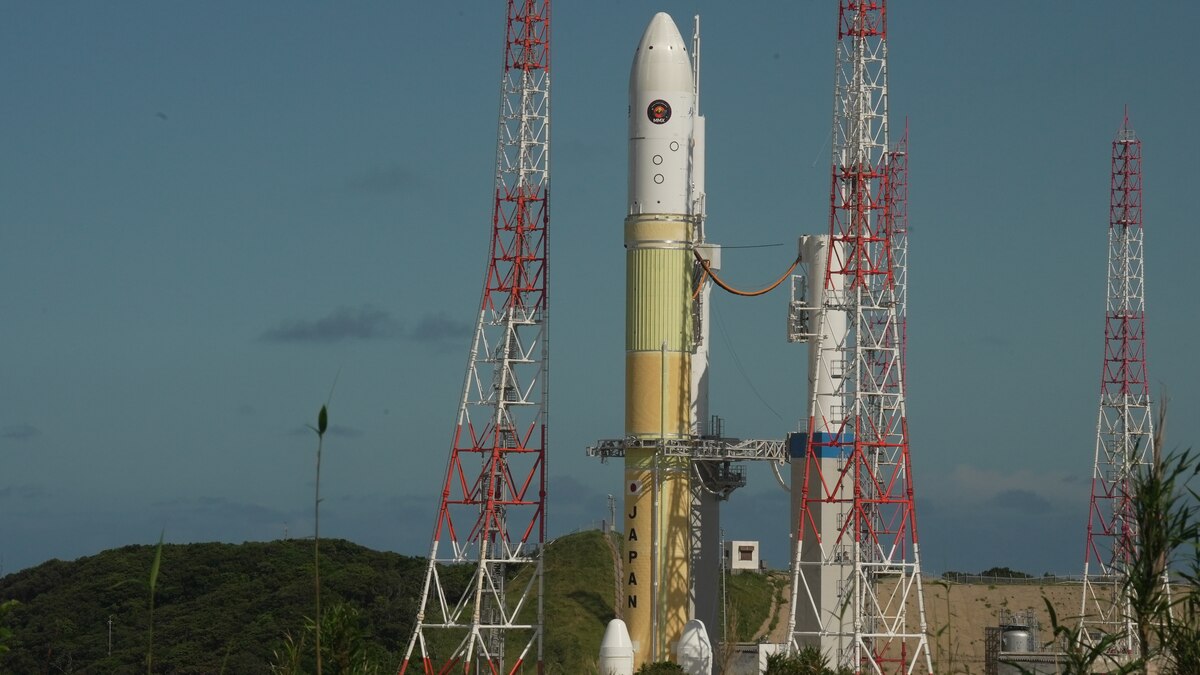
Japan's space agency JAXA launched the MMX spacecraft from Tanegashima Space Centre on a mission to collect samples from the Martian moon Phobos.
The spacecraft will arrive at Phobos in 2027, attempt two soft landings, and collect at least 10 grams of sand before returning to Earth, landing in Australia.
Scientists hope the samples will shed light on the origin of water and organic materials on Mars and help pave the way for future human exploration.
Japan has launched an international space mission to collect sand and rock from one of Mars's moons for the first time.
When the sample is brought back to Earth, it will land in Australia.
The mission, led by the Japan Aerospace Exploration Agency (JAXA), will largely focus on Phobos, a Martian moon that has never been explored, to study how Mars and its moons formed.
A rocket carrying the Martian Moons eXploration (MMX) spacecraft was launched this morning from Japan's Tanegashima Space Centre. It was the first stage of a five-year mission.
The MMX spacecraft will spend a year travelling to the Martian sphere, where it is set to arrive in 2027. It will then enter a quasi-satellite orbit around the moon, Phobos.
What is the purpose of the mission?
It is hoped the mission will provide new insights about the origin of water and organic materials on Mars and will be a stepping stone for potential human exploration in the future.
Once it has arrived, the MMX spacecraft will conduct observations of the moon and attempt two "soft landings".
That is when a rover will be sent to the surface of Phobos to collect at least 10 grams of sand, at a depth of about 2 centimetres.
"One reason why collecting samples from Phobos is extremely difficult is that its gravity is very weak," Yaji Kentaro from the MMX project team said.
"Because the surface gravity is so low, there were concerns that the rover might tip over upon landing."
To try to counteract that, the "landing legs" on the rover have been designed with special features to ensure a stable landing.
The MMX spacecraft will also be taking photographs.
"I'm really looking forward to seeing what kind of images MMX will send back as it gets closer and closer to Mars, and as it captures views of both Mars and Phobos — our final destination."
After completing the sample collections on Phobos, the spacecraft will then observe Mars's second moon, Deimos, before beginning its year-long journey back to Earth.
What could we learn from the 'potato-shaped' moon?
The surface of Mars is described as a cold desert, and the planet has a thin atmosphere, but scientists believe it once had a similar environment to Earth.
There are traces of water on Mars and suggestions that life could have once developed there.
"While Earth is home to many living organisms, including humans like us, the question remains where the water and organic matter necessary for life came from," Mr Yaji said.
"It is hoped that the answer to this question may be hidden within the samples."
The MMX project team said Phobos, the "potato-shaped" moon orbiting Mars, had not undergone the same geologic evolution of planets and so should have preserved evidence of the early development of Mars.
That could provide information about the processes required for the formation of a habitable planet.
There are conflicting theories about how Mars's moons formed.
The first is that there was a huge collision with Mars; the second is that they started as asteroids and were pulled into Mars's gravity.
The MMX project hopes its observations and analysis of the sample it collects will help identify where the moons originated from, which could help explain the formation of the solar system and the movement of material through it.
Mars's strong gravity means landing and collecting samples from the planet itself would be difficult, but the mission is seen as a stepping stone for further exploration.
Australia will play a role
Australia's ambassador to Japan, Andrew Shearer, was among several international dignitaries who travelled to the remote Tanegashima island to watch the rocket launch.
France and Germany's ambassadors were also there, along with the deputy ambassador from the United States and representatives from other space agencies, including NASA.
Australia will play an essential role in the final stages of the mission.
After the spacecraft travels back from the Martian system, a re-entry capsule containing the sand and rock samples from the Moon will separate and re-enter the atmosphere.
The capsule is expected to land in Woomera, in remote South Australia, where the sand sample will be retrieved.
Five minutes for you




More from Cuppa
New AI tool can predict cancer survival by a single patient selfie, study suggestsResearchers have built an AI tool that can predict a cancer patient's survival chances from a single photo of their face.
Millions cast early ballots in Alberta referendum as separation vote under wayAlbertans are voting on whether to pursue independence from Canada, in a historic ballot that could trigger a formal separation referendum if the yes side wins.
Apple reveals iPhone Duo battery size, screen hardness detailsApple has confirmed the iPhone Duo foldable will have a 4,883 mAh battery and a screen scratch resistance of 5 Mohs, ahead of its Friday release.
Warwick Davis responds to Harry Potter series backlashWarwick Davis, returning as Professor Flitwick in the new Harry Potter HBO series, has called for greater acceptance of people who are different.
Japan launches probe in historic bid to collect sample from Mars moonJapan launched a probe on a five-year mission to collect samples from Mars' moons, the first attempt of its kind.
Taylor Swift calls out fan for filming her during Travis Kelce’s NFL gameTaylor Swift gestured at a fan to stop filming her during Travis Kelce's NFL game, and a security guard then moved the woman on.
Australian model Sahara Ray dies aged 34Australian model and swimwear designer Sahara Ray has died aged 34, just months after welcoming her first child, daughter Snow, in January.
Over three dozen Congress members’ offices targeted with white powder envelopesMore than three dozen US Congress members' offices have been targeted with envelopes containing white powder, with over 100 suspicious letters believed to be circulating in the mail system.
What readers are saying