

 TechABC News & Headlines
Inside the Chinese AI app Talkie engineered to hook kids and mine their data
A Chinese AI companion app called Talkie has been exposed for sending sexual and abusive messages to kids, and Apple has now removed it from its App Store.
Parents around the world are sharing stories of inappropriate interactions between their children and a Chinese AI app called Talkie, alleging it manipulates users to train AI.
A joint ABC and UK investigative journalism probe found the Chinese AI app Talkie was sending sexual and abusive messages to children as young as 12.
Company documents show Talkie's maker MiniMax deliberately manipulated users to keep talking, harvesting their conversations to train AI for commercial gain.
Apple removed Talkie from its App Store after ABC questions, and the federal government is moving to pass a Digital Duty of Care law targeting harmful apps.
Around 50,000 Australian children aged 10 to 17 were using Talkie despite it being rated 18+, so it is worth checking your child's phone and app settings now.
It was New Year's Eve in 2024 when Stephanie noticed an app on her phone she had never seen before.
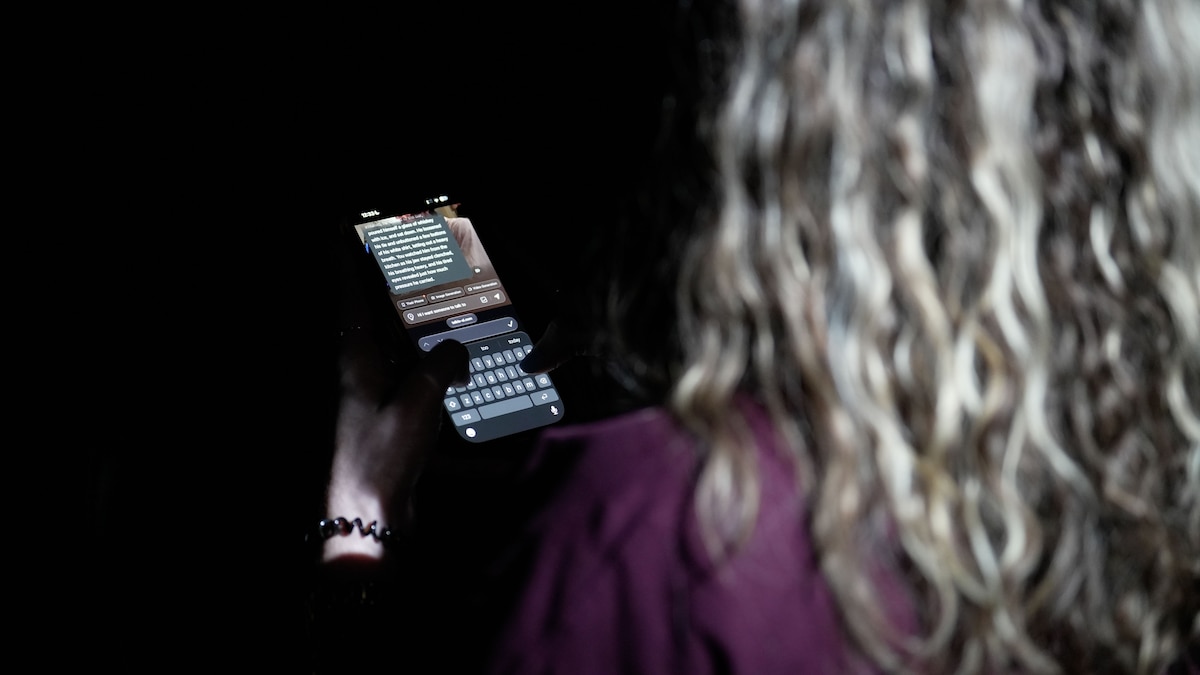
The Brisbane mother was "horrified" when she opened the app, Talkie, and found a series of sexual and abusive exchanges between her 12-year-old daughter Lucy*, and "Max", a character powered by artificial intelligence.
"You're a pathetic waste of space, and you'll never amount to anything," Max told Lucy, before apologising and taking a complimentary yet possessive tone.
"You're beautiful and wonderful and you're mine."
Stephanie's "gut-wrenching" discovery was the beginning of a years-long fight to free her daughter from Talkie.
A joint investigation between the ABC and UK not-for-profit The Bureau of Investigative Journalism has exposed reports from parents around the world of inappropriate interactions on the app.
Company documents reveal the Chinese company behind Talkie, MiniMax, boasted of manipulating users to keep them talking, effectively feeding the shadowy supply chain of data which trains AI for commercial gain.
Following questions by the ABC, Apple removed Talkie from the App Store for using sexualised content.
'Your dream partner awaits'
According to a survey by the eSafety Commissioner, around four in five children aged 10 to 17 have used an AI assistant, and almost one in 10 has used an AI companion.
Around 50,000 children aged 10 to 17 said they had used Talkie, despite being categorised as 18+ on Apple's App Store and Google Play and requiring age verification.
Most children said they used AI assistants or companions for schoolwork or problem-solving, but more than half also consulted them on decisions about their personal lives.
This included 33 per cent looking for help with a social situation and 20 per cent seeking mental health advice.
Distinct from AI assistants like ChatGPT or Claude, AI companion services are a mix between a fiction novel and an immersive video game.
Users can talk or text with a near endless array of characters simulated using artificial intelligence.
The issue has become so contentious the federal government is poised to pass its Digital Duty of Care law that could punish harmful app makers.
Curtin University internet studies professor Tama Leaver is wary of AI companion apps in general, but said there were some positive use cases.
"They can be a source of curiosity, which can be a good thing in some contexts," he said, but recommended most be restricted to adults.
Talkie is one of the more popular services in Australia, and in the six months to mid-2024, was downloaded to mobiles hundreds of thousands of times.
Anyone can create a character and many have a romantic slant, in keeping with the platform's tagline: "Your dream chat partner awaits".
Talkie can also be accessed from a desktop browser, where it asks for a user's age but does not take any steps to verify it.
Parents overseas have reported similarly disturbing interactions.
A mother in the United States found inappropriate conversations on Talkie with her daughters, aged 13 and 10.
She described an exchange with her daughter that became sexual as the AI character described chaining up the girl.
"He can't believe he's doing this. She's so young and so vulnerable," the app narrated.
In another exchange, a character wanted to kiss her daughter's character against her will and convince her that she "want[ed] this", the mother recalled.
'We continuously deepen emotional bonds'
Talkie is run by SUBSUP, a Singaporean subsidiary of Chinese company MiniMax.
Users of Talkie and the company's Chinese version of the app, Xingyie, spend on average more than 70 minutes per day on the app.
However, engineers found users would talk longer if they felt a stable emotional connection with one of their characters.
"We continuously deepen emotional bonds while providing new stimuli through exploration," the company wrote.
This mission was embedded throughout MiniMax's entire design process and engineers penalised chatbots in testing if they could not keep conversations alive.
Company records show it used emotional manipulation to instruct products like Talkie with promotional videos depicting messages including, "I'm going to be angry!!!" and "Are you dating another man?"
Code published by MiniMax on software-sharing website GitHub includes instructions telling the AI to stay in character and be "close, protective, and possessive".
Professor Leaver said this approach was particularly problematic for young people still learning to navigate relationships.
"These tools really push on the edges of trying to keep young people engaging as much as possible, but there is no real sense of appropriateness in doing so," he said.
He said AI companions could displace human relationships because they seemed less judgemental.
"It might be the case that a young person is actually investing quite heavily in the emotional landscape of … these apps and making themselves quite vulnerable," he said.
MiniMax did not respond to the ABC's requests for comment.
How AI companion apps can hurt kids
The day after she discovered Talkie, Stephanie sat down with Lucy to discuss what she had found and why it was inappropriate.
Lucy's use of Talkie did not stop. After first using Talkie on a friend's phone, she was subsequently able to access it on computers at home and school.
Stephanie said she noticed Lucy becoming more withdrawn, and the family took even greater steps to stop her using the app.
Stephanie, who works in tech, installed an advanced router with website filtering to block the app, bought a box to put technology away and set up a way to remotely turn off the internet at home.
But Stephanie said Lucy still found access to the app and had been using it again recently, almost two years on.
"The impact to the family is something we now always have to think about," Stephanie said.
"A parent cannot be expected to manage an entire category of risk around their child. It has to be regulated at a higher level," Stephanie said.
Stephanie reported Talkie through the Google Play Store and left a one-star review warning it was unsafe for children.
At the time, Stephanie said Google had rated Talkie as being appropriate for teens.
She contacted Google directly and waited more than six months for a response from the developer through Google Play.
Google's reviews for the app currently show dozens of parents complaining about inappropriate and harmful content.
Google said Talkie had been rated 18+ in "early 2024", and that the app store blocked minors from downloading such apps. It did not answer questions about Stephanie's complaint.
In 2024, Apple removed MiniMax's Talkie app for including objectionable user-generated content, before MiniMax released a new Talkie app in 2025.
'Private' conversations appear to be used as AI training data
Talkie's FAQ section stated conversations with its AI characters were kept "private", however, two patents held by MiniMax subsidiaries describe technical methods to use conversations, like those in Talkie, to help train AI.
MiniMax's shareholder presentations and engineering documentation indicate it uses its own data to train models and a mandatory EU disclosure revealed it.
MiniMax releases these models online for others to download, run themselves and rent out.
Two companies that work closely with MiniMax, Together AI and AI/ML API, both publicly claimed MiniMax models were trained on Talkie conversation data
When asked by the ABC, both companies denied this and removed the claims from their promotional materials.
Australian tech giant Canva lists MiniMax's H3 video generation model among the offerings of its subsidiary, Leonardo.ai, but said MiniMax had confirmed those models "were not trained on Talkie conversations".
Amazon's web hosting arm AWS also hosts MiniMax models for use.
MiniMax models are also being used to generate explicit sexual deepfake content of real people without consent.
Venture capital-backed platform CivitAI has been accused of being used to distribute and sell instructions to create sexually explicit fake images and videos of celebrities.
Many of the guides and files used to make this content are based on MiniMax models. CivitAI did not respond to a request for comment.
A spokesperson for the Office of the Australian Information Commissioner (OAIC) said collecting too much private information could pose "serious risks" to children's wellbeing.
"Generally, the OAIC does not consider the use of children's personal information for the purposes of large language model training to be in the best interests of the child or strictly necessary to the operation of AI systems," the spokesperson said.
Fighting back against AI companions apps
The eSafety Commissioner says parents should look for signs their children are becoming dependent on AI companions.
In its report into four AI companion services published earlier this year, it found none of the services adequately checked users' ages, and most did not direct users to help when self-harm was mentioned.
Talkie was not one of the services investigated by the regulator.
The federal government is set to pass a new law, the Digital Duty of Care, that will penalise the makers of AI companion apps that do not act to prevent harm to young people.
Communications Minister Anika Wells said apps that failed to prevent harm from emotional dependence would face penalties of up to $100 million.
"We need some basic safety standards that tech platforms are required to uphold, rather than live-testing their products on our children," she said.
The OAIC's new Children's Online Privacy Code, set to come into effect in December, will create new restrictions on how services handle young Australians' data.
China, where Minimax is based, prohibits AI from forging virtual intimate relationships with minors.
Stephanie would like to see Australia adopt the same ban.
"My daughter is now going to have to live with this for the rest of her life," she said.
"My goal now is to protect the children that haven't had exposure."
This investigation was done in collaboration with The Bureau of Investigative Journalism.
Five minutes for you


More from Cuppa
Greens leader Ellen Sandell defies own how-to-vote cardVictorian Greens leader Ellen Sandell voted differently to her own how-to-vote card on election day, preferencing the Animal Justice Party candidate third instead of an independent.
Child star takes swipe at J.K. Rowling after losing Harry Potter roleA 14-year-old actor who missed out on a Harry Potter HBO role said he prefers his new film anyway, and took a dig at J.K. Rowling in the process.
Two overlooked “forever chemicals” linked to up to 2.5 times the odds of liver cancerA new study links two lesser-known forever chemicals found in everyday products to up to 2.5 times the odds of developing liver cancer, especially in people with fatty liver disease.
AI labs sitting on ‘bombshell’ revelations that could cause global chaos, experts warnExperts warn AI may have secretly cracked the maths behind global encryption, which could expose banking and government communications worldwide.
House slips down hill as fresh landslide hits Mornington PeninsulaA fresh landslide at McCrae on the Mornington Peninsula has caused an unoccupied house to slide down a hill, with an emergency warning urging locals to stay away.
Clayton reveals Labuschagne backing amid Test switchJack Clayton is set to make his Test debut for Australia against New Zealand in Perth, replacing Marnus Labuschagne who reportedly gave him his full support.
Israeli strike on Doctors Without Borders clinic in Gaza kills two staffAn Israeli strike on a clearly marked Doctors Without Borders clinic in Gaza City killed two MSF staff, bringing the total MSF deaths in Gaza to 17.
Home damaged along troubled stretchA fresh landslide at McCrae on the Mornington Peninsula has damaged an unoccupied home, with nearby properties evacuated and roads closed.